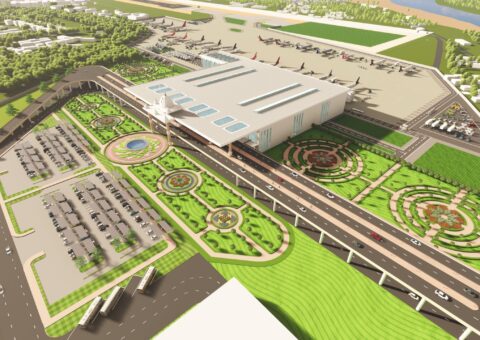
STHAPATI’s New Terminal at Jodhpur Celebrates the Spirit of Marwar
Jodhpur is one of India's most visited tourist destinations and, together with Jaipur and Udaipur, forms the state's popular tourism triad. As the gateway to Western Rajasthan, the city connects visitors to the larger Marwar region, with its tourism economy expanding beyond heritage sightseeing into luxury travel, destination weddings, and cultural experiences. As visitor numbers continue to grow, the terminal assumes a role not merely as transport infrastructure but as the first architectural and cultural introduction to the city. The city’s skyline is already defined by Mehrangarh Fort's commanding presence and Umaid Bhawan Palace, one of India's great royal architectural commissions. Beyond these landmarks, Ghanta Ghar, the historic bazaars, blue-painted settlements, and sandstone havelis form an architectural vocabulary immediately associated with Jodhpur. Jodhpur is often characterised by carved surfaces, openings with large overhangs, and jharokhas that emerged as much from responses to the region's hot-arid climate as from cultural expressions. The new terminal continues that vocabulary, translating the domes, arches, columns, and craft traditions of Rajputana into a contemporary aviation building. Here are the eight elements that define it.
1. A series of domes that marks the Moment of Arrival
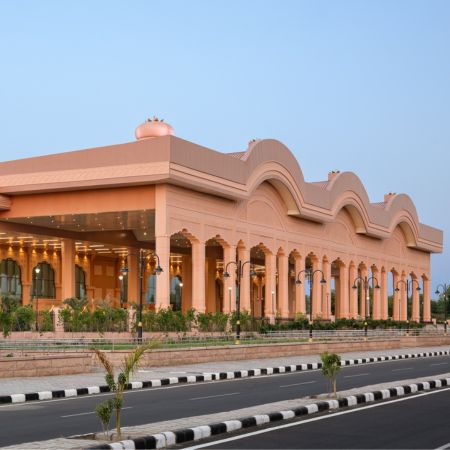
Domes have historically marked civic importance in Rajputana architecture, signalling significant public buildings across the region. The terminal's domes follow that convention, positioned as the markers of arrival. The dome is finished with a kalasa atop a lotus base, a detail that recalls traditional architectural symbolism while giving the building a recognisable civic identity.
2. Arches That Turn Repetition Into Rhythm
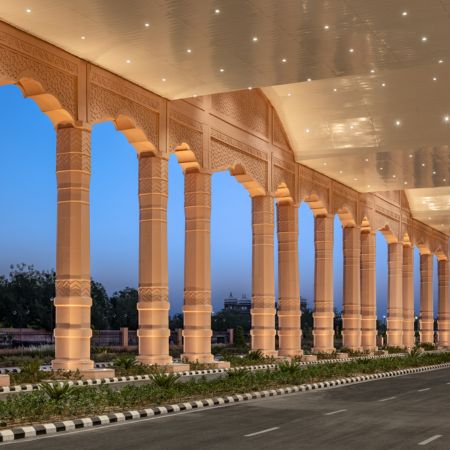
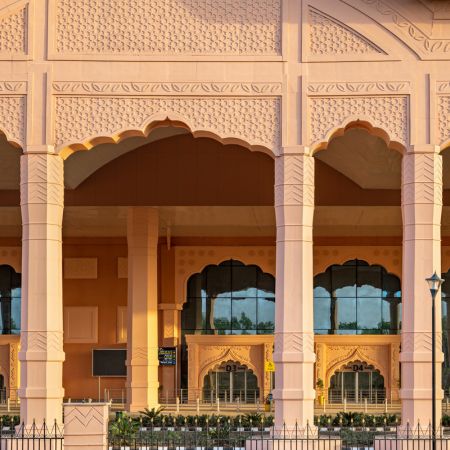
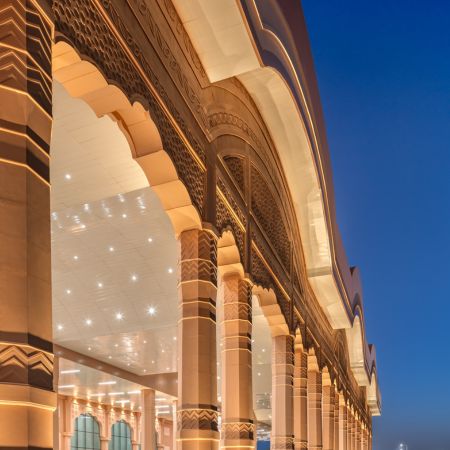
Multifoil arches have long been associated with Rajasthan's forts, palace courts, and ceremonial gateways. Rather than reproducing these historic forms as one-off features, the terminal adorns them in series across the building. This repeated profile is used to create rhythm and hierarchy, giving the space a contemporary architectural language that still stays rooted in regional identity.
3. Columns That Carry Centuries of Craft
The columns extend Rajasthan's tradition of intricately carved sandstone columns, which historically served both structural and ornamental roles in palaces, temples, and havelis. Their detailing combines Rajput elements such as lotus motifs and fluted shafts with Indo-Islamic, Mughal, and Solanki influences. Geometric lattice patterns and floral arabesques add further ornamentation, reflecting centuries of cross-cultural exchange and mathematical precision in the region's craftsmanship.
4. Recrafting Traditions in contemporary materials
Traditionally, these architectural elements were carved from sandstone, the material that has shaped Jodhpur's visual identity for centuries. At the terminal, they are recrafted in Glass Fibre Reinforced Concrete (GFRC), enabling the same intricate detailing with greater durability, precision, and construction efficiency. The craftsmanship changes medium, but its intent remains unchanged.
5. A Design Vocabulary Built for the Climate
Beyond the fort and palace, Jodhpur's architectural vocabulary includes carved sandstone surfaces and shaded openings. These elements originally served as environmental responses to Rajasthan's hot-arid climate as much as they did as cultural expressions. The terminal draws on the same vocabulary, carrying forward a design language that has always been both functional and decorative.
6. Murals That Turn Walls Into Canvas for Mythology
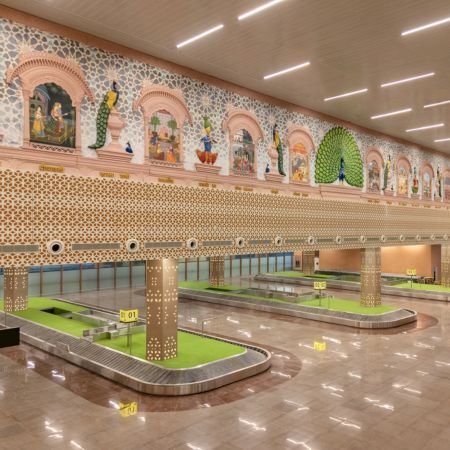
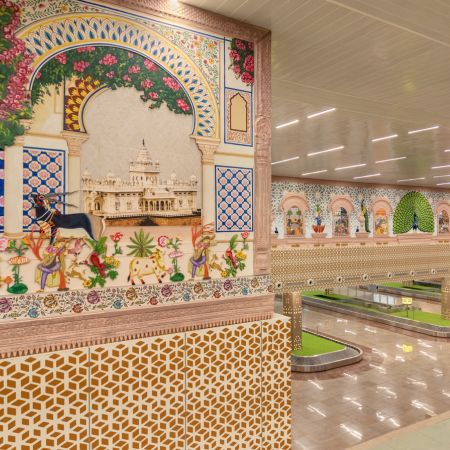
The terminal's interiors incorporate murals and decorative compositions inspired by Rajasthan's royal heritage and Marwar's artistic traditions. These draw from Hindu mythology, particularly stories from Krishna's life, as well as themes from the Ramayana. Royal courts, palace life, ceremonial processions, local landscapes, romantic narratives, and hunting scenes recur across the artwork, connecting the passenger experience to Rajasthan's larger cultural history.
7. A Palette Drawn From Three Painting Traditions
The artistic language inside the terminal blends indigenous Rajput traditions, Mughal court aesthetics, and elements of Deccan art. Themes such as Krishna Leela, Raag Mala, and the devotional traditions of Pichwai and Nathdwara painting appear alongside refined portraiture, courtly attire, and floral motifs influenced by Mughal painting. Regional wildlife, particularly peacocks and parrots, along with native flora, reinforces Marwar's visual identity throughout. The murals were developed in collaboration with regional artists, extending local craft practices into the terminal's public spaces.
8. A Terminal Designed as a Gateway
The overarching design approach treats the terminal as every traveller's first encounter with Jodhpur, where architecture becomes the medium through which the city introduces itself. Rather than functioning as an anonymous transport facility, the terminal is meant to communicate the identity of the place it serves. This isn't an attempt to recreate Rajasthan's historic architecture but to translate its principles, such as domes, arches and columns, into a contemporary public building at airport scale. Passenger movement, security, operational efficiency, and future scalability are addressed alongside this cultural expression, so the terminal functions as a modern airport while remaining connected to its context.
A city with an early aviation legacy
Jodhpur's relationship with aviation predates this terminal by nearly a century. Maharaja Umaid Singh established the Jodhpur Flying Club near Chittar Palace in 1931, and by the late 1930s, the city was a stop on international air routes served by Imperial Airways, KLM, and Air France. That early positioning as one of India's pioneering aviation centres forms the backdrop against which the new terminal continues Jodhpur's history of mobility and connectivity.
For generations, the experience of Jodhpur began at Mehrangarh Fort, within the blue lanes of the old city, or among its sandstone havelis. Today, that journey begins much earlier. The new terminal transforms the airport into the city's first architectural encounter, demonstrating that public infrastructure can do more than facilitate movement. By translating the principles of Rajputana architecture, regional craftsmanship, and Marwar's artistic traditions into a contemporary aviation building, the terminal positions itself as both a gateway and an expression of place—one that welcomes travellers with the identity of Jodhpur before they step into the city itself.