Are recent disasters a result of inadequate urban development strategies ?
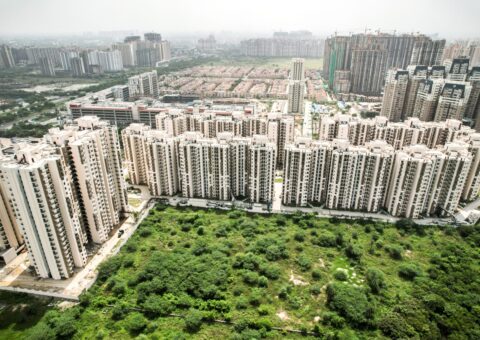
As India continues to expand vertically, our cities faces a pressing question: can urban density coexist with livability? High-rises are an inevitable response to shrinking land and rising populations, but if built without care, they risk stripping the city of its lungs: its green spaces, walkable streets, and microclimates. The challenge, therefore, is not to resist verticality but to design it as an opportunity for human and ecological well-being.
At STHAPATI, we approach high-rise living not as stacked apartments but as vertical neighbourhoods, layered ecosystems where people, community, and nature interact at multiple scales. Done well, density can be transformative. Done poorly, it can alienate and exhaust. The responsibility lies in how we design for civic life and ecological resilience.
Designing for Vertical Communities
Too often, high-rise developments maximise floor area but minimise human comfort. Blank façades, sealed corridors, and podium-level open spaces create sterile environments that disconnect residents from one another and from nature. Instead, high-density housing must be envisioned as civic architecture, where green terraces, sky gardens, and shared decks punctuate the elevation.
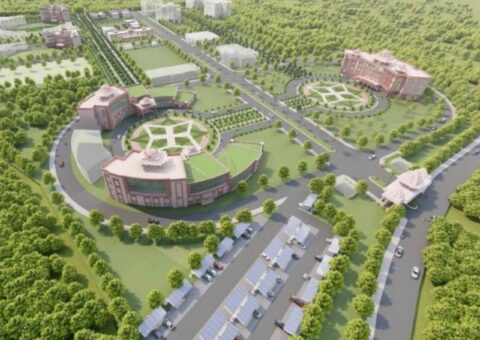
At Golf Homes and Kingswood housing project in Noida, we explored this principle at scale. Spanning 8,50,000 sqm of built-up space for nearly 24,000 residents, the project was designed around expansive open landscapes, including a 9-hole executive golf course repurposed as a shared green podium. This elevated landscape is a breathing, recreational, and social hub that counters the anonymity often associated with large housing developments. The central greens, inward courtyards, and community clubs act as connective tissue, transforming towers into neighbourhoods.
Such distributed green strategies mitigate the urban heat island effect, manage stormwater, and provide shaded breathing spaces at multiple levels. More importantly, they create opportunities for chance encounters, intergenerational play, and the social connection that is essential for livability in community spaces.
Policy and Planning: Rethinking Density
Density in itself is often not the problem; it is the quality of life affected when cities are not planned effectively that creates concern. Urban planning policies in cities like Delhi must evolve to encourage qualitative density benchmarks like minimum green coverage on vertical surfaces, mandatory semi-public terraces, and incentives for passive sustainable design elements.
Singapore and Tokyo already employ density bonuses for developers who integrate green infrastructure and public open spaces. Similar strategies could be adopted to balance compact growth with urban resilience.
At the Leisure Park project, Noida, this philosophy guided our approach. Despite accommodating nearly 3,000 families across 30 towers, 26 acres of the site were consciously planned around a one-acre retreat, amphitheatre, and interconnected circulation networks. Minimal surface parking and shaded, landscaped pathways turned the ground into a porous, walkable, climate-responsive zone. By treating public, private, and semi-public open spaces as a continuum, the project fostered inclusivity and well-being without compromising density.
Retaining the Ground: Walkability and Microclimates
As towers climb skyward, the ground must remain breathable. Shaded streets, bioswales, permeable pavements, and small-scale parks recalibrate microclimates and make daily life tolerable in extreme summers.
This principle shaped the design of the Golf Homes Project, where nearly 80% of the site was preserved as landscape. The built-up footprint was limited to 20%, distributed vertically into eight clusters. Each cluster was anchored around courtyards equipped with sports amenities, gardens, and play zones, ensuring that density did not erase porosity. Such low-tech, climate-sensitive design interventions are vital for sustaining livability as Indian cities grow denser.
Towards Resilient Vertical Urbanism
Livability in dense cities depends on how thoughtfully we design for complexity. High-rise living should not be seen as a compromise, but as a chance to reimagine resilient communities, where shaded courtyards, breathable streets, and rooftop greens coexist with smart infrastructure and social amenities.
Our projects stand testament to how density can become a framework for ecological restoration, social vibrancy, and inclusivity. These townships demonstrate that verticality, when planned with green infrastructure and walkability, can foster not just housing but thriving ecosystems.
India’s future will be tall, but height alone cannot define its success. The true test lies in whether we can ensure that vertical growth does not mean a loss of human comfort, ecological balance, or civic responsibility.