Designing Carbon-Efficient Cities Through Smarter Brownfield Strategies
Brownfield redevelopment is the cornerstone of sustainable urban planning, yet the blanket assumption that reusing contaminated land automatically reduces carbon footprint is deeply flawed. As cities race toward Net-Zero goals, we must question whether the design and long-term operation of these projects actually deliver the carbon savings they promise.
Understanding the Carbon Equation, Beyond Site Reuse
Brownfield development only saves carbon when design decisions are intentional; land reuse alone does not guarantee sustainability. The environmental benefit depends on three interconnected considerations:
Embodied Carbon Preservation: Reusing or adapting existing structures avoids the large carbon cost of demolition and retains the energy already embedded in materials.
Operational Energy Performance: Buildings must be designed for long-term efficiency. Low-performing systems create a persistent carbon debt that offsets any initial benefit from site reuse.
Systemic Mobility Impact: Locating projects along high-connectivity transit corridors enables a modal shift away from private vehicles, reducing daily transport emissions over the building’s lifespan.
Without examining this full lifecycle cascade, the perceived sustainability of a brownfield project can be misleading. True carbon benefit is determined by how effectively a redevelopment reduces dependence on driving, lowers operational energy demand, and preserves embodied carbon—not by land reuse alone.
Redeveloping Sites Near Transit Nodes as a Strategy for Reducing Carbon Emissions
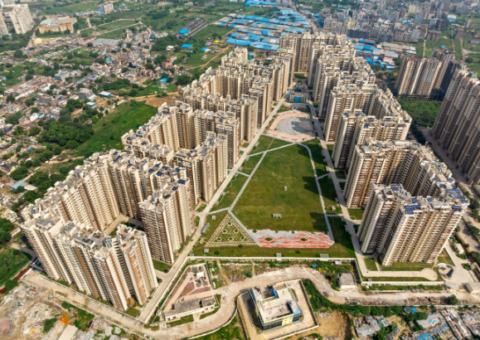
Brownfield sites located along high-connectivity corridors offer the strongest case for carbon reduction when redeveloped intelligently. Their integration into existing transit networks can reduce household Vehicle Miles Travelled (VMT) by up to 52% compared to conventional greenfield developments, resulting in substantial long-term operational carbon savings.
Transit-oriented brownfield transformation initiates a powerful cascade effect: compact, mixed-use development adjacent to transit accelerates modal shift, maximises the carbon efficiency of existing infrastructure, and avoids the embodied carbon burden of building new systems on greenfields. Channelling growth into these corridors allows cities to decouple urban expansion from rising emissions, positioning infill development as a strategic lever for a low-carbon future.
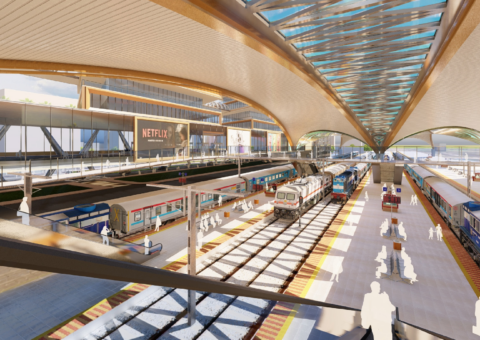
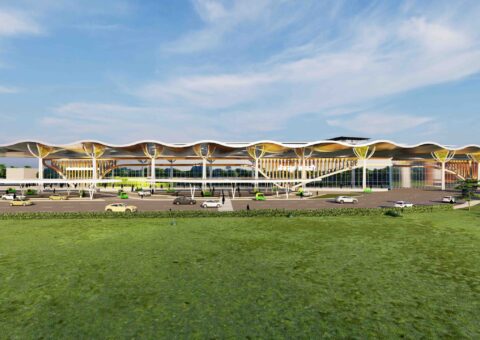
The redevelopment of Andheri Railway Station in Mumbai illustrates how a high-intensity brownfield intervention can contribute to carbon-efficient urbanism. Located in a hyper-mobility zone, the project reimagines one of the city’s busiest nodes as a multimodal interchange with concourses, foot-overbridges, vertical commercial activity, and integrated circulation networks. By stacking programmes above transit infrastructure and consolidating movement into structured vertical flows, the design reduces spatial sprawl, shortens travel distances within the node, and supports long-term modal shifts. In such contexts, brownfield sites function as carbon sinks not by default, but by restructuring everyday journeys through spatial logic.
Emphasising Ecological Regeneration Instead of Replacement
Some brownfield sites sit within ecological systems where environmental restoration must take precedence over urban replacement. In these contexts, carbon reduction emerges from strengthening natural cycles, improving microclimates, and integrating climate-adaptive design.
The Kishore Sagar Lake Redevelopment in Kota, Rajasthan, demonstrates how contextual sensitivity can redefine brownfield transformation. The project re-engages the lake’s sacred identity while stabilising its ecological edge through spatial zoning, controlled human access, and the reintroduction of cultural activities that reinforce stewardship. By foregrounding landscape performance, the redevelopment shifts brownfield thinking from land reuse to land healing, with implications for atmospheric cooling, reduced surface temperatures, and carbon sequestration through renewed biodiversity.
Toward Carbon-Efficient Urban Futures
The long-term carbon outcome of brownfield redevelopment hinges on operational efficiency. Sustainability is defined by the critical carbon equation: adaptive reuse to save embodied carbon, low operational energy demand to prevent carbon debt, and transit-oriented placement to leverage systemic mobility effects.
Brownfield redevelopment represents more than a tool for urban expansion—it is an opportunity to rethink how cities function, how people move, and how natural systems are restored. The sites themselves can become instruments of systemic change: shaping low-carbon mobility patterns, enabling efficient use of infrastructure, and supporting ecological regeneration. Success requires viewing each project not in isolation but as part of a larger urban metabolism, where decisions on design, location, and program ripple across environmental and social systems. By prioritising integrated planning, context-sensitive interventions, and lifecycle-aware design, future cities can transform brownfield sites into catalysts for resilient, climate-conscious urbanism.