Infrastructure as Economic Mirror – Tracing India’s $3 Trillion Journey Through Built Form
India’s economic trajectory is often assessed through growth rates, investment volumes, and fiscal targets. Infrastructure offers a more direct reading of financial priorities. Decisions related to mobility, access, scale, and spatial distribution translate economic intent into physical systems that determine how cities expand, how labour circulates, and where opportunity consolidates.
India’s movement toward a $3 trillion economy is visible in its mobility infrastructure—roads, rail, metro systems, airports, logistics corridors, and public transport networks. These projects can foster regional pride and confidence, showing how growth has been organized spatially and which urban regions are structurally enabled to participate in the economy.
Infrastructure growth in Tier 1 cities
In the decades following liberalisation, investment in mobility infrastructure was primarily concentrated in Tier 1 cities. Expressways strengthened metro-to-metro corridors, metro rail systems were introduced primarily in large urban centres, suburban rail upgrades prioritised established city regions, and airport expansion focused on already dominant nodes. Infrastructure was shaped by density and demand, reinforcing existing urban hierarchies rather than reshaping them.
The built environment of this phase prioritised capacity and operational efficiency. Mobility systems were designed to support faster movement within and between major cities, with limited attention to regional integration, land-use transformation, or employment dispersal. Architecture and engineering responded to throughput requirements, reflecting an economy oriented toward concentration and scale.
Connectivity as an Economic Restructuring Tool
Recent infrastructure investment indicates a strategic shift, with mobility networks increasingly used to reshape economic geography by integrating Tier 2 and Tier 3 cities into national systems of movement and exchange.
These interventions directly influence employment distribution. Improved connectivity enables industrial, institutional, and service-sector activity to locate beyond Tier 1 cities. Infrastructure projects also generate layered employment—during construction, through operations, and via secondary development that follows improved access. In this context, mobility infrastructure functions as an economic enabler rather than a city-specific service.
Built Form as Long-Term Economic Evidence
From a design and urban planning perspective, mobility infrastructure provides one of the clearest indicators of economic intent. Roads, rail corridors, transit systems, and terminals establish durable patterns of access and land use that shape development trajectories over decades.
Recent increases in capital expenditure on infrastructure underscore the state’s reliance on mobility systems to support sustained growth. More instructive than aggregate spending, however, is the spatial distribution and integration of this infrastructure with the surrounding urban fabric. Projects that anticipate expansion, support mixed-use development, and strengthen regional networks point to an economy seeking to broaden participation.
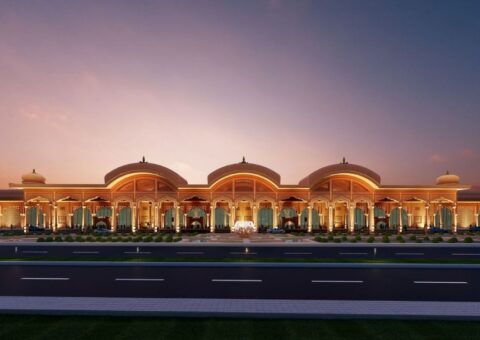
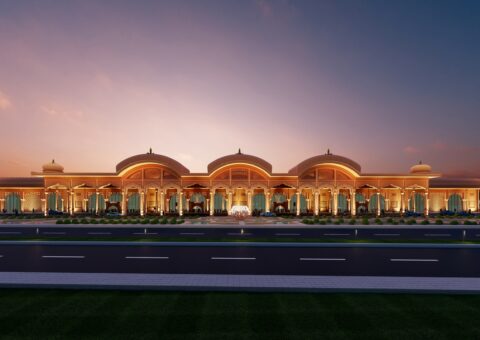
In recent years, STHAPATI’s projects have contributed to mobility and urban infrastructure across multiple regions. Airports in Bagdogra, Belagavi, Leh, Jammu, Jodhpur, Ayodhya, Darbhanga, Varanasi, and Kempegowda Terminal 1, alongside railway stations, civic upgrades such as Kishore Sagar Lake, and institutional campuses including IIT Mumbai and UP State University, illustrate how infrastructure shapes regional connectivity. These projects enable labour and service mobility beyond metropolitan centres, support local economic activity, and anchor new urban development around transport nodes. By integrating operational efficiency with regional planning, such interventions expand participation in national economic flows and demonstrate how infrastructure can function as a structural tool for distributed growth.
The Question Going Forward
As India continues to invest heavily in mobility infrastructure, the critical question is no longer whether connectivity will be built, but how strategically it will be aligned with urban development, employment generation, and regional planning.
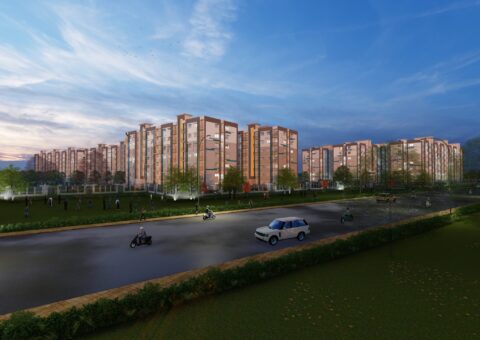
If mobility infrastructure remains disconnected from land-use policy and local economic capacity, it risks reproducing earlier patterns of concentration. Conversely, planning as part of an integrated spatial framework—linking transport, housing, institutions, and services—can inspire a sense of purpose and responsibility in urban development.
For architects, urban planners, and infrastructure practitioners, this moment demands a shift in focus from designing for movement alone to planning for long-term economic structure. The built environment will continue to act as an economic mirror.