Rethinking Airport Terminal Design with Context and Performance
In India’s rapidly growing aviation sector, terminals must reconcile high passenger volumes, operational efficiency, and regional identity, all within the constraints of climate, site, and future growth. The challenge lies in designing spaces that are resilient and culturally resonant without compromising on comfort or sustainability.
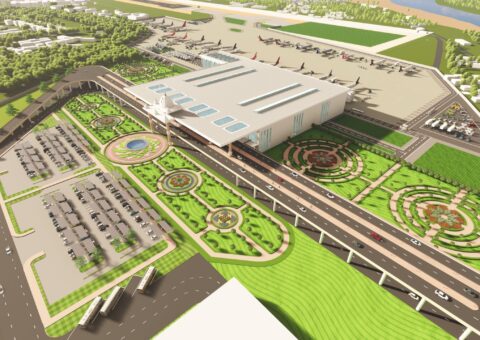
Streamlined Passenger Flow through Layered Spatial Engineering Efficient circulation is the backbone of any modern airport. In India’s rapidly expanding aviation sector, design must anticipate peak passenger volumes while maintaining comfort and orientation. At Kempegowda International T1 & Jodhpur Airport New Terminal T2, departures and arrivals are arranged in a single-level configuration, with six aerobridges strategically positioned to facilitate rapid boarding and faster turnaround times for aircraft to increase efficiency levels. The airport’s island-style check-in counters and linear security lanes are planned to reduce cross-flows and eliminate unnecessary congestion.
This layered spatial approach is echoed at Bagdogra Airport too, where a different approach is followed, and the terminal’s tiered layout separates public, staff, and service circulation. Integrating vertical and horizontal flows through discrete pathways ensures that operational systems coexist with public areas without visual or functional interference. These innovations demonstrate how careful architectural and engineering coordination can convert complexity into seamless passenger experiences.
Passive Climate Strategies Embedded in Terminal Design
Energy efficiency is increasingly inseparable from airport architecture. Across STHAPATI’s recent projects, terminals employ passive cooling and daylighting strategies while respecting local climatic conditions.
At Jodhpur Airport, for instance, deep overhangs and lattice façades filter harsh sunlight while promoting natural ventilation, thereby significantly reducing mechanical cooling loads. Glass Fibre-Reinforced Concrete (GFRC) panels emulate local sandstone textures without the carbon cost of quarrying. Bagdogra Airport reinterprets Himalayan vernacular forms with sloped roofs, large overhangs, and terraced landscaping, controlling heat gain and integrating rainfall management into the building envelope. Similarly, at the upcoming T2 in Varanasi, vernacular facades help reduce significant solar heat gain within the building envelope.
These approaches highlight how engineering and architectural detailing work in tandem, allowing buildings to remain climate-responsive while minimising operational carbon footprints, without compromising spatial quality or aesthetics.
Integrating Cultural Identity into Structural Innovation
Modern airport design need not forsake regional identity. Instead, architecture and engineering can reinforce cultural narratives within high-tech infrastructure. At Lal Bahadur Shastri International Airport in Varanasi, structural elements and interior layouts are informed by the city’s sacred rivers and temple typologies. At the same time, motifs inspired by the ‘Shikara’ are woven into the terminal envelope.
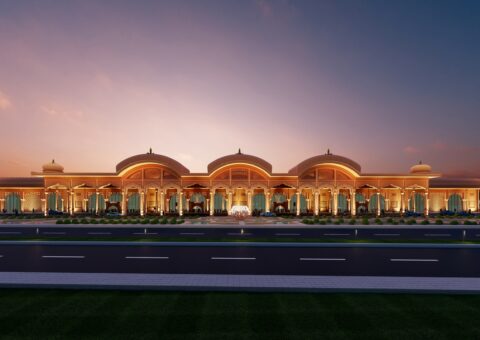
Similarly, Jodhpur Airport’s fluted domes, jharokhas, and multifoil arches reinterpret Rajputana heritage in contemporary materials and forms. Here, engineering ensures structural stability under high passenger loads, while architecture mediates daylight, views, and orientation, creating spaces that resonate with local identity. This approach demonstrates that cultural integration and technical performance are mutually reinforcing rather than competing priorities.
In conclusion, as airports in India’s Tier-II cities evolve to meet surging demand, the role of innovative architecture and engineering becomes pivotal. Projects such as Jodhpur, Varanasi, and Bagdogra Airports demonstrate that when design and engineering collaborate at every level, terminals can transcend their utilitarian function to become civic landmarks.