Institutional Campus Expansion and the Architecture of Continuity
When a legacy institution expands, the challenge extends beyond accommodating new programs or increasing capacity. The central question is one of identity: how growth can occur without disrupting the spatial logic and cultural patterns that define the institution.
Educational campuses function as lived environments where movement, pause, encounter, and solitude structure everyday academic life. Over time, these patterns become embedded in both physical form and collective behaviour. Expansion must engage with these systems, recognising that the campus operates as an evolving framework shaped through use.
Negotiating Brownfield Complexities to Maintain Existing Patterns
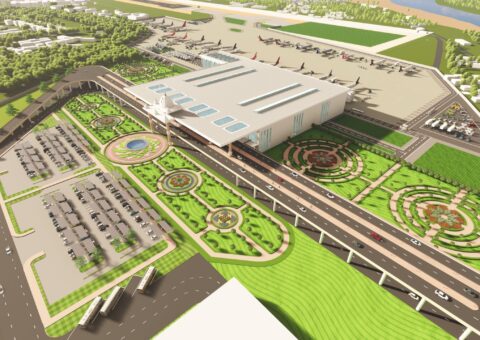
Expansion within a brownfield campus requires negotiating existing systems rather than reworking them. Circulation networks, mature landscapes, and established building typologies create a tightly interdependent environment. Planning builds on these existing hierarchies to keep growth legible and student-oriented. New interventions extend the circulation spines, reinforce the relationships between the academic and residential zones, and maintain the role of open spaces in structuring campus life.
At the level of use, expansion responds to how academic environments function. Informal exchange, departmental proximity, and shared spaces shape collaboration. Positioning new buildings to support these patterns ensures that growth strengthens existing relationships. As universities expand their academic and research capacities, spatial frameworks must adapt while maintaining coherence. This approach acknowledges that institutional growth is tied to ambition.
Optimising Limited Land Through Strategic Densification
At campuses such as the Indian Institute of Technology Bombay, this is compounded by ecological sensitivity and rising academic demand. Additional teaching spaces and capacity must be accommodated within the available land. The new research hub addition to this campus adopts a densification and vertical growth approach to optimise the available area while maintaining open spaces on campus. The intervention balances institutional growth with environmental sensitivity.
Harnessing Environmental and Regional Context to inform design
As much as campus architecture is inseparable from its geographic and cultural context, today it is also closely tied to the intangible context of aspirations and ambitions. At the Indian Institute of Technology Jodhpur, planning engages directly with climate and terrain. Courtyard-based configurations and shaded transitional spaces structure movement while moderating harsh environmental conditions. The built form is organised to create a sequence of interconnected spaces, in which terraces at varying levels enable interaction, visibility, and continuity across the campus.
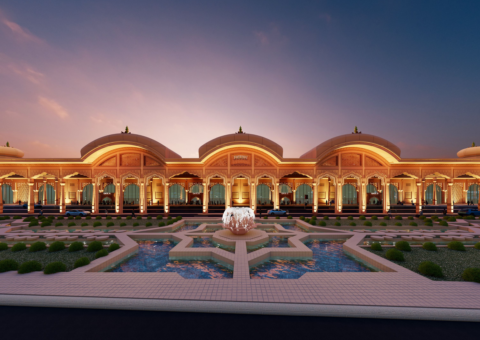
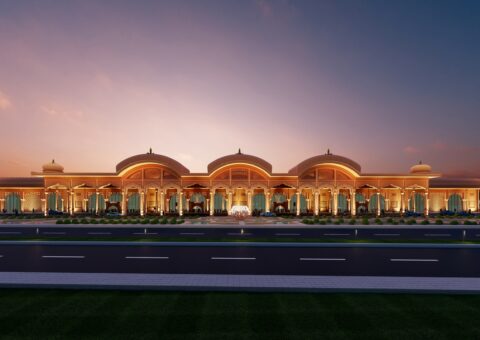
At sites with strong historical and cultural associations, such as Balrampur, architecture draws from regional narratives. References to temple architecture and local spatial traditions inform the organisation of the campus, embedding cultural identity within contemporary institutional frameworks. In such cases, expansion becomes a means of reinforcing place-based identity rather than introducing a generic architectural language.
In other contexts, such as institutional developments in Uttar Pradesh, expansion is closely tied to upgrading infrastructure to meet evolving academic ambitions. Here, planning aligns new spatial systems with long-term institutional vision, ensuring that growth supports both immediate requirements and future scalability.
Human-Scale Detailing to Foster Institutional Culture
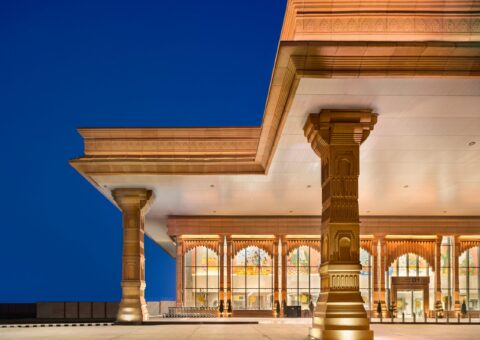
While planning establishes structure, detailing shapes experience. Material choices, thresholds, and transitions influence how spaces are perceived and inhabited. Climatic responses such as shading devices or screened facades often carry cultural memory, allowing environmental performance and identity to converge. These decisions affect how habits form within the campus. The routes students take, the spaces where interactions occur, and the environments that support both concentration and exchange collectively define institutional culture. Expansion that recognises and sustains these patterns contributes to continuity at a human scale.
Extending the Institutional Ethos as a Mode of Sustainable Evolution
Campus designs must evolve in response to new academic models, increased scale, and shifting aspirations. Institutional expansion is a process of managing continuity within this change. In brownfield institutional developments, the role of design extends beyond accommodating new requirements; it lies in planning such that expansion remains sensitive to the institutional values, spatial logic, and patterns of use that have evolved over time. The distinction lies in recognising that expansion is not defined by the addition of built area, but by the extension of an existing ethos.